Theory III: Computational Graphs
The previous notebooks have illustrated that if you have a set of pure functions with explicit interfaces, you can reason about the dependencies between them.
Such a set of functions thus defines a computational graph: nodes are the functions and the directed edges connecting them are the outputs and inputs of the functions.
We’ll re-use the functions from before and draw the computational graph:
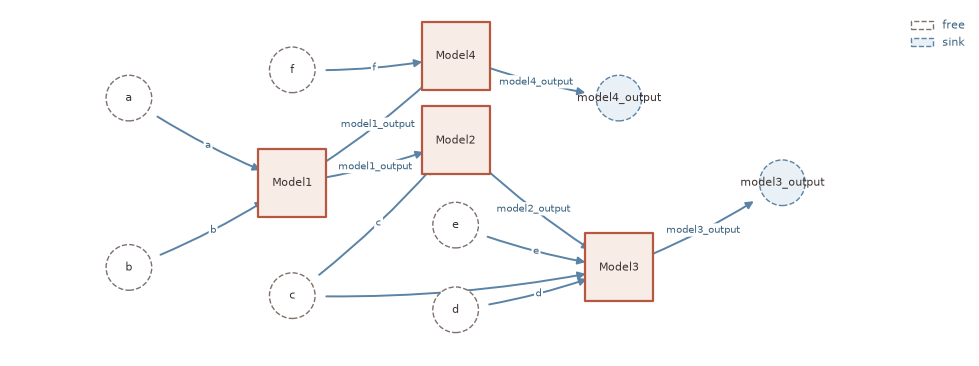
If an order exists in which the functions can be executed one-by-one, the computational graph is a directed acyclic graph (DAG). This notebook only considers these graphs; for cyclic graphs, see the next notebook.
Standard algorithms exist to determine a valid ordering of a DAG. To determine this order, we’ll use the networkx library. Below is some code to transfer our models to the networkx graph format.
Then, we can compute a valid ordering [1]
nx_digraph = models_to_graph([Model4, Model3, Model2, Model1])

list(nx.topological_sort(nx_digraph))
['Model1', 'Model4', 'Model2', 'Model3']
The basic evaluation that is valid for any combination of models that form a DAG is then as follows (we also add a check that the input data structure matches what we’d expect):
def TotalModel(data_structure, models : set):
    ds_start = data_structure.copy() # Keeping it pure: the original data structure is not modified, but a copy is used instead.

    # Let's also check that the provided data structure has all the required external inputs for the given models:
    if not set(external_inputs(models)) == set(ds_start.keys()):
        raise ValueError(f"The provided data structure keys {set(ds_start.keys())}" +
                         f"do not match the required external inputs {set(external_inputs(models))} for the given models.")

    # Create the graph and order it:
    nx_digraph = models_to_graph(list(models))
    str_to_model = {model.__name__: model for model in models}
    models_in_order = list(nx.topological_sort(nx_digraph))

    # Rest the same as before:
    for model_name in models_in_order:
        model = str_to_model[model_name]
        # Get the interface for the current model
        interface_i = interface(model)[model.__name__]

        # Prepare the inputs for the current model based on its interface
        inputs = {input_name: ds_start[input_name] for input_name in interface_i["inputs"]}

        # Call the model with the prepared inputs
        output = model(**inputs)

        # Update the data structure with the output of the current model
        ds_start.update({interface_i["outputs"][0]: output})
    return ds_start

ds_start = {"a": 1.0, "b": 0.5, "c": 2.0, "d": 0.1, "e": 0.2, "f" : 3.0}
TotalModel(ds_start, {Model1, Model2, Model3, Model4})
{'a': 1.0,
 'b': 0.5,
 'c': 2.0,
 'd': 0.1,
 'e': 0.2,
 'f': 3.0,
 'model1_output': 0.8075731482210419,
 'model4_output': 3.8075731482210418,
 'model2_output': 9.901012037547295,
 'model3_output': 1.9113901980206618}
and it will error if we put something there that is not an external input for the given models:
ds_wrong = {"a": 1.0, "b": 0.5, "c": 2.0, "d": 0.1, "e": 0.2, "f" : 3.0, "model1_output" : 4.0}

try:
    TotalModel(ds_wrong, {Model1, Model2, Model3, Model4})
except ValueError as ve:
    print(f"ValueError: {ve}")
ValueError: The provided data structure keys {'model1_output', 'd', 'a', 'c', 'f', 'b', 'e'}do not match the required external inputs {'f', 'b', 'd', 'e', 'a', 'c'} for the given models.
Great! Let’s use an alternative for Model4 that uses Model3 output instead of Model1 output[3]
def Model4(a, model3_output):
    return a + model3_output


nx_digraph = models_to_graph([Model4, Model3, Model2, Model1])
print(list(nx.topological_sort(nx_digraph)))
['Model1', 'Model2', 'Model3', 'Model4']
The topological order has immediately changed to reflect this new dependency!
We can also immediately run it ( after removing the now-useless f input):
# remove `f` now!
ds_start = {"a": 1.0, "b": 0.5, "c": 2.0, "d": 0.1, "e": 0.2}
TotalModel(ds_start, {Model1, Model2, Model3, Model4})
{'a': 1.0,
 'b': 0.5,
 'c': 2.0,
 'd': 0.1,
 'e': 0.2,
 'model1_output': 0.8075731482210419,
 'model2_output': 9.901012037547295,
 'model3_output': 1.9113901980206618,
 'model4_output': 2.911390198020662}
Alternative models
We can now solve the alternative problem. Let’s define a way to switch between two models:
def make_model4(model4_i : bool):
    if model4_i:
        def Model4(a, model3_output):
            return a + model3_output
    else:
        def Model4(model1_output, f):
            return model1_output + f
    return Model4

def make_model5(model5_i : bool):
    if model5_i:
        def Model5(model4_output, f):
            return model4_output + f
    else:
        def Model5(model2_output, model3_output, f):
            return model2_output + model3_output + f
    return Model5
We can immediately create the graph and see the various possibilities:
def create_graph(model4_i : bool, model5_i : bool):
    Model4 = make_model4(model4_i)
    Model5 = make_model5(model5_i)
    nx_digraph = models_to_graph([Model4, Model3, Model2, Model1, Model5])
    print("Topological ordering: ", list(nx.topological_sort(nx_digraph)))
    return draw(to_graph(Model1, Model2, Model3, Model4, Model5), formatter = PlainFormat(), boundary = True)

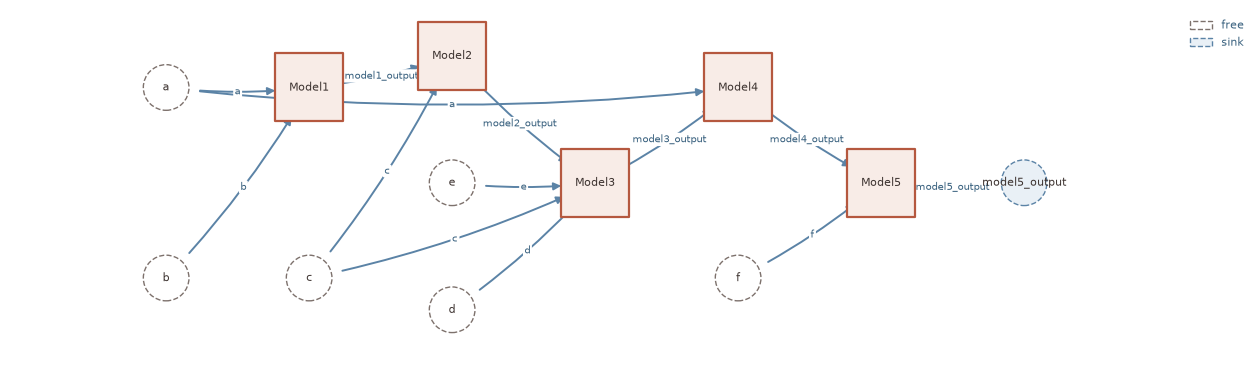
_ = create_graph(True, True)
Topological ordering: ['Model1', 'Model2', 'Model3', 'Model4', 'Model5']
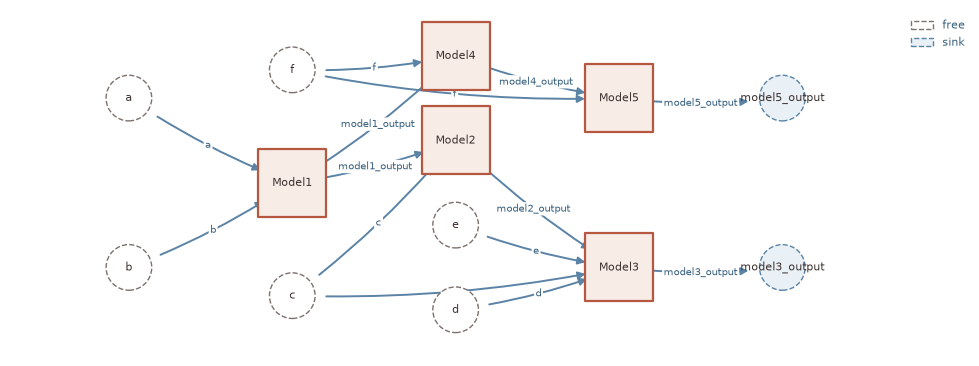
_ = create_graph(False, True)
Topological ordering: ['Model1', 'Model4', 'Model2', 'Model5', 'Model3']
_ = create_graph(False, False)
Topological ordering: ['Model1', 'Model4', 'Model2', 'Model3', 'Model5']
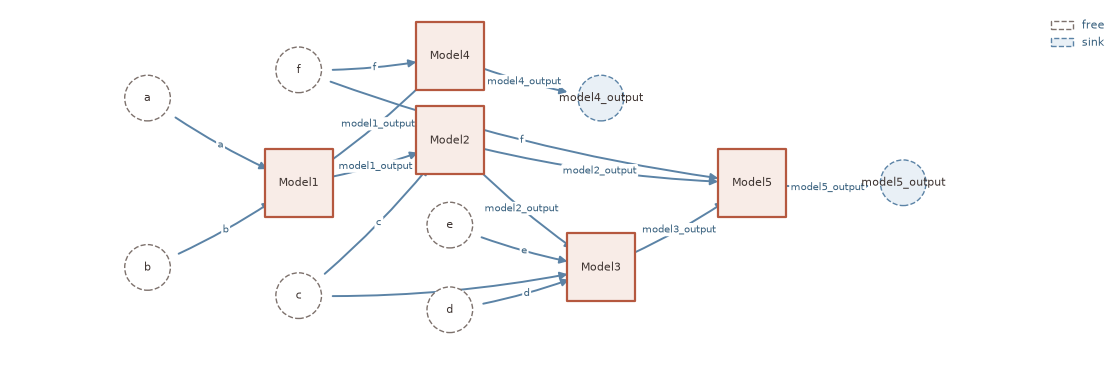
These graphs are rather cluttered and difficult to analyse by hand; this is precisely the point! An algorithm can analyse these very fast and create a valid ordering and do the analysing for you, as long as you have the pure functions and explicit data interfaces![4]
Summary
Explicit data interfaces and pure functions define a computational graph, which standard algorithms can use to define a valid ordering between the models.
Thus, given a collection of models, you don’t need to hand-order them, this can be done automatically!
In the next notebook, we’ll look at collections of models that cannot be ordered because of a dependency cycle.